

I Failed the Personality Test (Part 2)
This is the second of a five-part reflection on the intersection of personality and career.
It came out years into my career, based on my Strengthfinder personality profile, Gallop stamped an X on my application. I was deemed unworthy; an unfitting character for a collaboratively chaotic and creative culture.
What mix of personality themes was so egregious that lil’ ole fresh college graduate Dan was “unrecommended” for a job that would later prove to be a perfect fit?
Belief (read part 1)
Empathy
Includer (read part 3)
Maximizer (read part 4)
Positivity (read part 5)
EMPATHY
Gallup’s definition of the Empathy theme is simple and loaded: “People exceptionally talented in the Empathy theme can sense other people’s feelings by imagining themselves in others’ lives or situations.”
When I was in high school, a lot of my classmates smoked weed. Three elective classrooms were particularly vulnerable to nefarious activities: Computer programming, graphic design and guitar. A tilted music stand gave the perfect cover for rolling joints in the back row. Computer monitors equally obstructed teacher sight-lines. “Dan, check this out.” Adam was supposed to be learning Adobe Illustrator by working on a screen-print t-shirt design. Instead, he was gleaming with pride over a giant doobie he just crafted in the middle of class. He raised his hand for a bathroom break, then disappeared for 20 minutes before returning to his chair with bloodshot eyes.
These are the moments that defined my teen years. At the start of 8th grade, my friends and I started a band. They liked Metallica, so I did too. We cut our chops by covering 90s grunge and pop-punk songs; Nirvana, Offspring, Blink 182. What emerged with us out of puberty was a taste for hardcore metal. We started writing original music, booked a few shows and won a local battle-of-the-bands. Suddenly we had a cult following of committed fans. Almost by surprise, I found myself toe-to-toe with an audience of angry kids from broken homes.
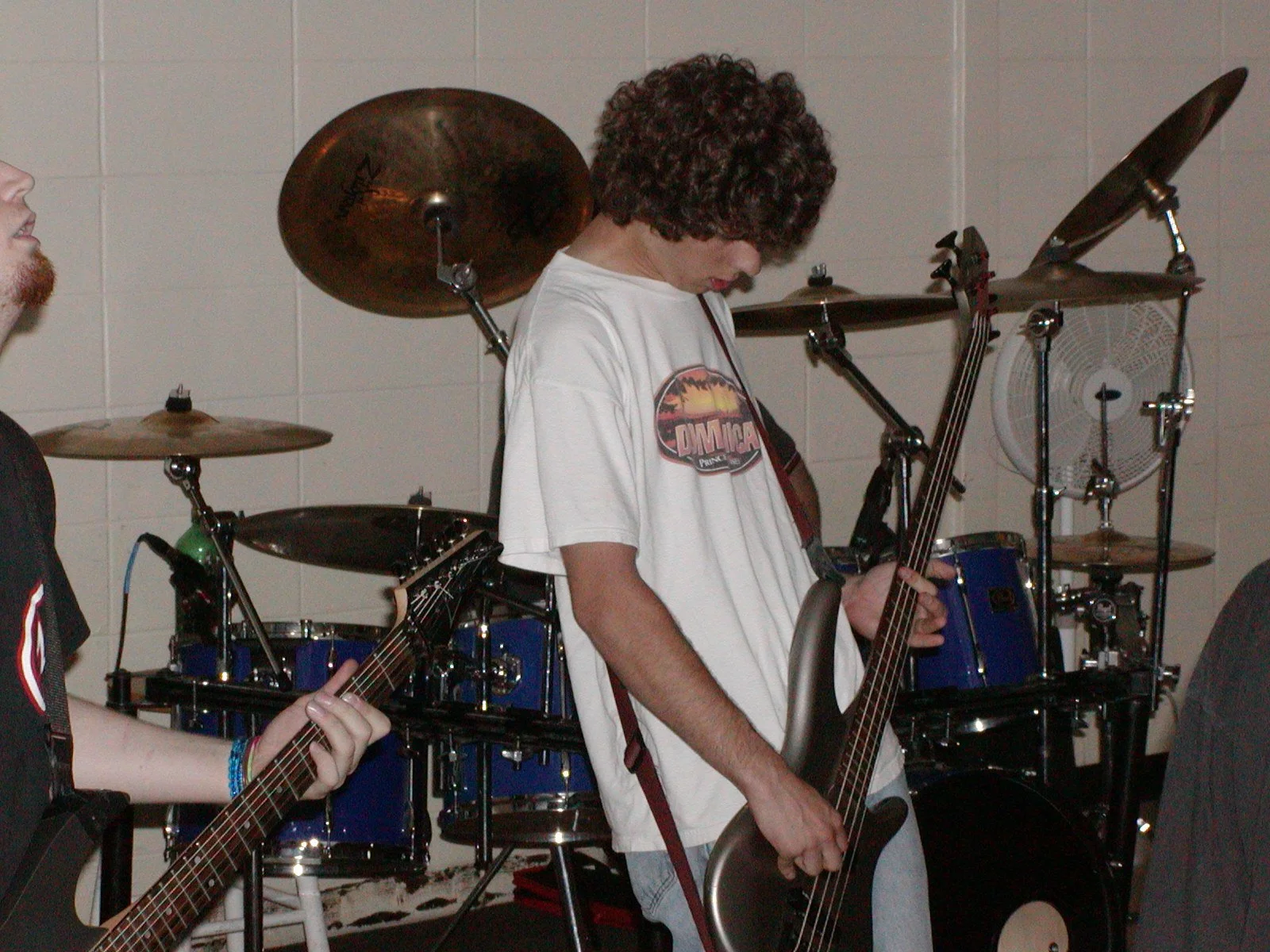
High School me playing bass in a benefit concert at my church.
As a kid, I was shy. I always had big feelings, but I could never find the words to match. My parents were likely very surprised when I chose to “emote” by joining a hardcore heavy metal band. When the girl I liked wouldn’t talk to me (even though I never talked to her), all I could do to express my frustration was aggressively bang my head and flail across the stage. One night, I landed in the emergency room because my face head-banged into our guitar player’s tuner knobs. It hurt, but I didn’t realize my nostril had ripped until all the drunks at the bar suddenly started cheering. Apparently all you need to engage a crowd is a little alcohol and a little (a lot of) spattering blood. I still remember the X on my hand, indicating my underage status for the barkeeper. My parents trusted me to stay out of trouble, so I did, for the most part. I had my private sins, but my public morals were unwavering.
My first encounter with seeing “both sides of an argument” came from doobie-rollin’ Adam who used the bible to justify his operation. He, seeing that I was a church kid, wanted my take on a few passages of scripture.
“Then God said, “I give you every seed-bearing plant on the face of the whole earth and every tree that has fruit with seed in it. They will be yours for food.”
I could have been offended that he wasn’t really interested in Jesus… he just wanted to feel ok about smoking. Probably because he felt like it was wrong. I mean, I thought it was wrong. But I never stopped to consider why. This was the first time I recognized my “superpower”… my desire wasn’t to win the argument. I didn’t go tit-for-tat with different scriptures to refute his justifications. On one hand, I wasn’t equipped to. I was baptized as an infant, but had only just recently given my life to Christ. I was still hanging out in the shallow end of faith. I was more concerned with being kind than being judgemental. Instead of giving answers, I asked questions. “What evidence do you have that smoking weed has been good for you? Is it helping or impeding your education? Have you contemplated the risks and rewards? Is it mostly beneficial or mostly not?” Admittedly, as an early Christian, my worldview was morally binary. Smoking was wrong. Cussing was wrong. Bullying was wrong. Sex before marriage (I was nurtured by purity culture) was wrong. It was learning to ask questions that nurtured comfort with ambiguity, gave me peace about things I didn’t understand and strengthened my sight through lenses not my own.
A few months later, Adam secretly poured vodka into my coke can at a party. An empathetic friend who respected my boundaries told me before I took a drink. I was confused. Why would Adam do that? Probably because empathy was farther down his list.
Life’s most rewarding content isn’t accessible through a screen. Life is multi-everything. It’s actually not about content at all. It’s about context.
it was a meme that sent me on an enlightening journey of understanding a sliver of human psychology.
Let me set the scene.
2024. Paris. Olympics.
If you watched the opening ceremonies, you’re probably familiar with the dumpster fire that followed. After a triggering depiction of what many Christians thought was the Lord’s Supper, Galatians 6:7 became the most quoted scripture of all-time (what felt like it, at least).
“Do not be deceived: God is not mocked, for whatever one sows, that will he also reap.” Galatians 6:7 ESV

A controversial scene from the opening ceremonies of the Paris Olympics in 2024.
The level of offense was staggering. Christians from every corner of the theological map put up their dukes to defend Leonardo’s sacred painting as though it were God himself. The original painting of the Last Supper is one of the most parodied expressions in history. It was painted 1,498 years after Jesus walked the earth, and 318 years before the invention of the camera. My first reaction to the vile garbage fight of slanderous accusations was confusion, “How in the world did a painting cause so much chaos?”
I was about to pick up a flaming banana peel to ignite a theological blaze of my own, but that’s when my professional clinical counselor wife texted me a meme:
The Dunning-Kruger Effect – The cognitive distortion in the self-image of incompetent people to overestimate their own knowledge and ability.
This was all I needed to understand the totality of all things happening to everyone everywhere; the simple idea that people don’t have enough knowledge to know they don’t have enough knowledge. Or as Albert Einstein said, “the more I learn, the more I realize how much I don’t know.” The Dunning-Kruger effect suggests that one’s confidence level soars at the ice-berg-tip of information. Having read “an article” you may feel like you know everything there is to know about something. Or, like me, after seeing a meme about the Dunning-Kruger effect, you now have a PhD in psychology. Or, like millions of Christians after the 2024 Olympic opening ceremonies, you thought drag queens around a dinner table was intentionally designed to mock your creator.
The producer of the opening ceremonies responded to the controversy by sourcing his reference: “The Feast of the Gods”, depicting Dionysus, Greek God of fertility, painted by Jan van Bijlert around 1637. In other words, not mocking anything.
I gave my life to Jesus in 1999, when I was 16 years old. My faith then was confident and bold. My faith now is unorthodox and curious. I thought the pursuit of truth would bring answers! The more I travel, the more cuisine I try, the more people I meet, cultures I experience, conversations I have, books I read, teams I root for, new things I try… I have more questions than answers. Adventure exposes new realities; new and exciting expressions of God’s character I previously knew nothing about.
Our greatest drop in Christian witness followed a drop in our collective emotional intelligence;A lack of empathy;Solutions without context. With context there is alwaysa better solution.
I began to embrace empathy as a super power when I shifted from graphic design to video storytelling early in my career. Below is an example of two very different people with similarly tragic stories. In fact, Jesse and Earl could not be any politically different! Yet an afternoon with each of them left a scar on my heart and a realization that most people are more similar than we realize.
In Palestine, I learned about Sulha, the traditional Arab community-based process for resolving conflict. It’s a restorative approach: the goal isn’t “who wins,”, it’s repairing the social fabric so the conflict doesn’t keep spreading. It uses third-party mediators, a cooling-off period to stop escalation, negotiation, dignity and compromise. Using acknowledgments to restore honor, the Sulha process forces enemies to see each other as friends. It’s an exercise in seeing the world through your enemy’s eyes. Empathy allows zero room for dehumanization. Empathy builds a world where your enemy is a friend in waiting.
Stay curious, y’all. It’ll save us. I promise.
And Jesus. Jesus will save us, too. I couldn’t leave that unsaid.