

The Secular Design World Has A Moral Stance On AI. Does The Church?
Ginghamsburg’s Change the World Conference was (at the time of me writing) last week. One of the keynote speakers was my good friend Jason Moore. Jason worked in the creative department at Ginghamsburg in the late 1990s. I owe him a lot of credit for blazing a trail for my career and the careers of other church media creative professionals. I’ve admired his ability to adapt to the cutting edge of technology and his quest to yank the church out of tired traditions.
Tradition offers a helpful entanglement with the past, but only to a degree. Some traditions we hang on to because they’re comfortable. Some traditions don’t produce the same fruit they used to. Some traditions are timeless, but others are time-bound. I always carry questions of tradition when I enter conversations about worship design. There’s an understanding, somewhere deep inside of me, that much of what we hold on to is for survival. We’ve carried the same order of worship on Sunday mornings since coming out of the pandemic. It’s possible that the pandemic shocked us into a risk-averse mindset.
Is there a reason that it’s always SONG//SONG//SONG//CONNECTIONS//OFFERING//MESSAGE//SONG?
Sure, there’s always a reason. But nothing sacred. Yet our rhythms, methods and models become sacred when we become scared.
Jason has traveled all over the country to help churches become less scared. Originally a talented illustrator (like, hand drawn illustrations with ancient tools like pen and paper), he has done well to integrate digital tools into his creative workflow.
Since the conference’s theme was “the future church”, Jason was asked to speak about AI.
Usually, the church is way behind in the adaptation of new technology. Even Ginghamsburg, I feel, lags behind, and we’ve been teachers of it. But something feels different this time around.
“The church has an opportunity,” Jason teaches, “things can be different this time. We can be ahead of the curve if we take AI seriously, because it’s here to stay whether we like it or not.”
I’ve generally taken the same approach. AI has been an incredible creative partner. I’m still learning about the cost, and am still mindful of my malleable ethics of using AI. I have learned that an open approach is usually best. Certainly for my personal workflows, AI has guided me to faster outputs. Whether or not those outputs are “better” is up for debate, but I’m quickly on my way to a 3-day work week. I am writing faster, designing faster, building fast, dreaming faster and editing faster.
Faster is not always better. It certainly feels better though, if it means extra time off.
My friend Will always reminds me that, “new technology should move us toward worker liberation, not the trap of more work.” Many of my questions of AI and the future revolve around this idea. If I can do more good work faster, do I get punished for that by moving to part-time with lesser pay? Do I get punished for that by staying full time and filling my hours with more to do? What’s the relationship between capacity and efficiency and sanity?
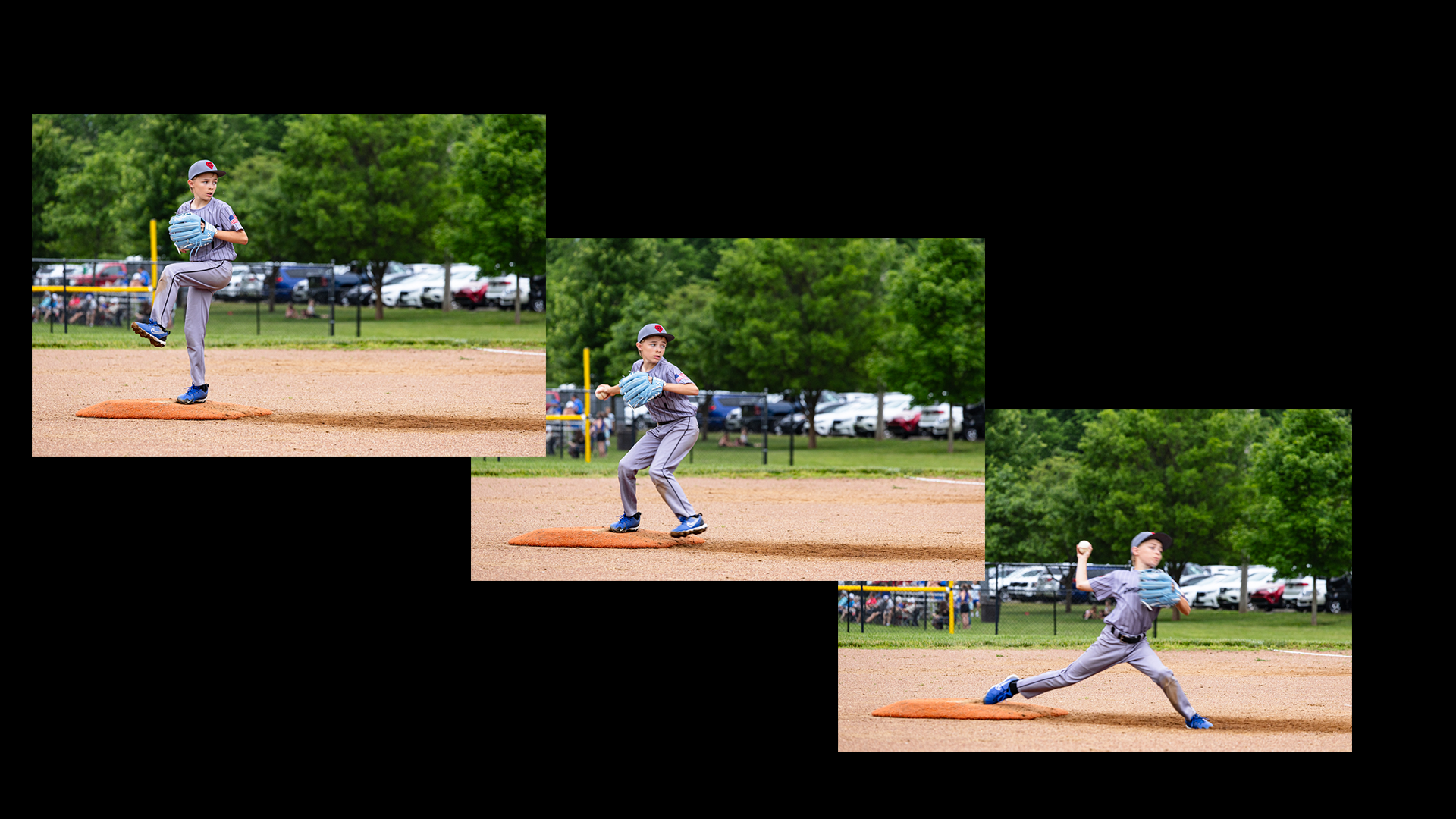
Three original photos of my son pitching.

ChaptGPT prompt: Make a dramatic still-frame blend of these three photos to show his pitch sequence. Add dramatic flare and effect that a middle schooler would think is cool. Flames or lightning or something. Change his environment to something like an MLB stadium with crowd in the background. HDR, mixed media, motion blend.
My friend Tracey just started a Discord server for Dayton Designers. (If you’re a Dayton Designer, join us HERE). One of the text channels is designated to share recent work. I shared a photo collage of Ben pitching that I created with ChatGPT. My feeling was existential. I prompted what was in my head. I could’ve created the same output after weeks in photoshop, but ChatGPT got me there in less than five minutes and a single iteration. I felt the industry of graphic design evaporate in that moment. I will continue as a designer, but only because I like it. It may no longer be a viable way to make money.
Two years ago my friend Isabelle asked me to redesign the logo of her pet grooming salon. This year, when she started a new coffee truck business, she went to ChatGPT for a new logo instead. I’ve seen a handful of former clients do the same.
I discovered that the Dayton Design community is vehemently against the use of any AI. AI art is not art. It’s stealing. It’s lazy. It’s wrong. They kinda chewed me out.
That really bothered me. Was I farther along, or lagging behind? Does the secular world have a stronger moral answer to AI than the church?
I asked Ginghamsburg’s executive pastor, Jordan McKenzie, that question. What he said gave me pause: “I think the church’s approach has been mostly utilitarian.”
Most pastors are using AI the same way I am, for personal benefit. Shortcuts to freedom. Ministry is really hard, but much of that is the administrative work of running a business. Or being a therapist. Or being a marketing expert. Or being a speech writer. Or being a preschool specialist. Or being a musician. Or being an author. Or being a fundraiser. I think most of us in ministry are looking for freedom, so we can do the one thing we’re really being called to do. Do you blame us for being overly utilitarian with our use of AI?
Dang it.
The secular design community is calling it evil. That’s probably hurting our witness, huh?
Are we actually…behind again?
Though I work in the creative department at Ginghamsburg, my job is highly relational. I’m not fully threatened by the loss of graphic design as an industry. Graphic design is a small part of what I do. But there is an entire industry of workers who are afraid. What would Jesus do?
As the church moves forward, she needs to be careful. AI can offer us advantage. But in the mess, we can’t forget that in us, the poor should find their advantage. If it’s not good news for the poor, then it’s not the gospel. As the gaps of knowledge, wealth and access widen, the church needs to hold strong. Not all that glitters is gold. I don’t think the luddites have it right either… but certainly a life in the middle takes careful evaluation.